

Research field
Geometric and Riemannian robot learning
Learning and control are formulated directly on manifolds and Lie groups, not on flattened approximations of them. This keeps what a robot learns consistent with the structure of the space it moves in.
About this field
Orientations, stiffness matrices and robot configurations are not flat vectors — they carry curvature and constraints. We formulate learning and control directly on these manifolds, so that generalization respects the structure of the space instead of working around it.
People

Hozefa Jesawada
The research covers safe learning-based control for soft and continuum robots. It also develops Grassmannian methods for null-space control.
Hozefa Jesawada is a Postdoctoral Researcher at New York University Abu Dhabi. He earned his PhD in Information Technologies for Engineering from the University of Sannio, Italy, and subsequently worked as a postdoctoral researcher at the University of Salerno. His research focuses on reliable decision-making and control for robotics, combining tools from optimization, uncertainty-aware learning, inverse optimal control, and robust planning.
He is particularly interested in how principled learning methods can support embodied intelligence in real robotic systems, including manipulation, model-based formal control, and safety-aware autonomy.
Ikhlas Ben Hmida
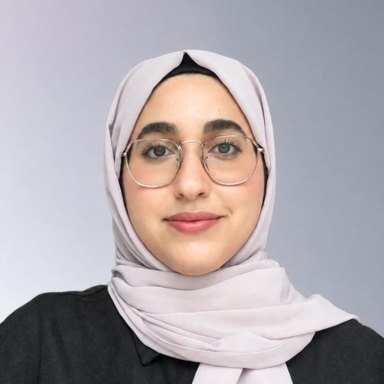
The research covers the modelling and design of a soft prosthetic hand. It also explores data-driven decoding of hand and finger motion from surface electromyography.
Ikhlas Ben Hmida is a Global Ph.D. fellow from NYU Tandon School of Engineering and a visiting graduate research assistant at the REACH Lab at NYUAD, where she is conducting her PhD research.
Her research interests include soft robotics, bio-inspired systems, and medical applications of robotics. She is currently exploring data-driven approaches to decoding hand and finger motion from surface electromyography (sEMG) to advance human-machine interfaces and dexterous prosthetic and assistive hands.

Omar Mostafa
The research is on stable robot learning, including stable dynamical-systems control. It also covers vision-language-guided policy learning and simulation environments for manipulation.
Omar Mostafa is a Global PhD student in Electrical and Computer Engineering. His research interests are robot learning and control, with a focus on physics-informed reinforcement learning and world models for robotic manipulation.
Previously: Graduated magna cum laude from NYU Abu Dhabi with a bachelor’s degree in Electrical Engineering.
Narayana Reddy Marthala
The research covers contact control for space robots. The robots studied are dual-arm and free-floating.
Publications since 2024
Constrained Trajectory Optimization on Matrix Lie Groups via Lie-Algebraic Differential Dynamic Programming
Systems & Control Letters (SCL), vol. 204
@article{alcan2025constrained,
  author        = {Alcan, G. and Abu-Dakka, F. J. and Kyrki, V.},
  title         = {{Constrained Trajectory Optimization on Matrix Lie Groups via Lie-Algebraic Differential Dynamic Programming}},
  journal       = {Systems \& Control Letters},
  year          = {2025},
  volume        = {204},
  pages         = {106220},
  doi           = {10.1016/j.sysconle.2025.106220},
  eprint        = {2301.02018v3},
  archivePrefix = {arXiv}
}
MeshDMP: Motion Planning on Discrete Manifolds using Dynamic Movement Primitives
IEEE International Conference on Robotics and Automation (ICRA)
@inproceedings{dallevedove2025meshdmp,
  author        = {Dalle Vedove, M. and Abu-Dakka, F. J. and Palopoli, L. and Fontanelli, D. and Saveriano, M.},
  title         = {{MeshDMP: Motion Planning on Discrete Manifolds using Dynamic Movement Primitives}},
  booktitle     = {IEEE International Conference on Robotics and Automation (ICRA)},
  year          = {2025},
  pages         = {895--901},
  publisher     = {IEEE},
  address       = {Atlanta, GA, USA},
  doi           = {10.1109/ICRA55743.2025.11128556},
  eprint        = {2410.15123v2},
  archivePrefix = {arXiv}
}
Learning Periodic Skills for Robotic Manipulation: Insights on Orientation and Impedance
Robotics and Autonomous Systems (RAS)
@article{abudakka2024learning,
  author  = {Abu-Dakka, F. and Saveriano, M. and Peternel, L.},
  title   = {{Learning Periodic Skills for Robotic Manipulation: Insights on Orientation and Impedance}},
  journal = {Robotics and Autonomous Systems},
  year    = {2024},
  volume  = {180},
  pages   = {104763},
  doi     = {10.1016/j.robot.2024.104763}
}
EEG Motor Imagery Classification: Tangent Space with Gate-Generated Weight Classifier
Biomimetics
@article{omari2024eeg,
  author  = {Omari, S. and Omari, A. and Abu-Dakka, F. and Abderrahim, M.},
  title   = {{EEG Motor Imagery Classification: Tangent Space with Gate-Generated Weight Classifier}},
  journal = {Biomimetics},
  year    = {2024},
  volume  = {9},
  number  = {8},
  pages   = {459},
  doi     = {10.3390/biomimetics9080459}
}
A Unified Formulation of Geometry-Aware Discrete Dynamic Movement Primitives
Neurocomputing
@article{abudakka2024unified,
  author        = {Abu-Dakka, F. J. and Saveriano, M. and Kyrki, V.},
  title         = {{A Unified Formulation of Geometry-Aware Discrete Dynamic Movement Primitives}},
  journal       = {Neurocomputing},
  year          = {2024},
  volume        = {598},
  pages         = {128056},
  doi           = {10.1016/j.neucom.2024.128056},
  eprint        = {2203.03374v3},
  archivePrefix = {arXiv}
}
Safe Execution of Learned Orientation Skills with Conic Control Barrier Functions
IEEE International Conference on Robotics and Automation (ICRA)
@inproceedings{shen2024safe,
  author    = {Shen, Z. and Saveriano, M. and Abu-Dakka, F. J. and Haddadin, S.},
  title     = {{Safe Execution of Learned Orientation Skills with Conic Control Barrier Functions}},
  booktitle = {IEEE International Conference on Robotics and Automation (ICRA)},
  year      = {2024},
  pages     = {13376--13382},
  publisher = {IEEE},
  address   = {Yokohama, Japan},
  doi       = {10.1109/ICRA57147.2024.10611325}
}
CITR: A Coordinate-Invariant Task Representation for Robotic Manipulation
IEEE International Conference on Robotics and Automation (ICRA)
@inproceedings{so2024citr, author = {So, P. and Cabral Muchacho, R. I. and Kirschner, R. J. and Swikir, A. and Figueredo, L. and Abu-Dakka, F. J. and Haddadin, S.}, title = {{CITR: A Coordinate-Invariant Task Representation for Robotic Manipulation}}, booktitle = {IEEE International Conference on Robotics and Automation (ICRA)}, year = {2024}, pages = {17501--17507}, publisher = {IEEE}, address = {Yokohama, Japan}, doi = {10.1109/ICRA57147.2024.10611312} }G3VLA: Geometric inductive bias for Vision-Language-Action Models
Preprint arXiv preprint — not yet peer-reviewed
@misc{peng2026g3vla,
  author        = {Peng, Yue and Zhao, Yongzhe and Habuda, Artur and Pham, Khuyen and Zhu, Yanheng and Le, Tran Nguyen and Abu-Dakka, Fares and Guo, Li},
  title         = {{G\textsuperscript{3}VLA: Geometric inductive bias for Vision-Language-Action Models}},
  year          = {2026},
  eprint        = {2606.24472},
  archivePrefix = {arXiv},
  note          = {Preprint, not yet peer-reviewed},
  url           = {https://arxiv.org/abs/2606.24472}
}
Stable Robot Motions on Manifolds: Learning Lyapunov-Constrained Neural Manifold ODEs
Preprint arXiv preprint — not yet peer-reviewed
@misc{boetius2025stable,
  author        = {Boetius, David and Abdelnaby, Abdelrahman and Kumar, Ashok and Leue, Stefan and Swikir, Abdalla and Abu-Dakka, Fares J.},
  title         = {{Stable Robot Motions on Manifolds: Learning Lyapunov-Constrained Neural Manifold ODEs}},
  year          = {2025},
  eprint        = {2510.05707},
  archivePrefix = {arXiv},
  note          = {Preprint, not yet peer-reviewed},
  url           = {https://arxiv.org/abs/2510.05707}
}