

Research field
Neural interfaces and assistive robotics
We decode human intent from muscle and brain activity. We then close the loop through prosthetic and wearable devices that respond to it.
About this field
Reading human intent from biological signals — muscle and brain activity — and closing the loop through prosthetic and wearable devices that respond to it, including the sensory feedback that makes them feel like part of the body.
People
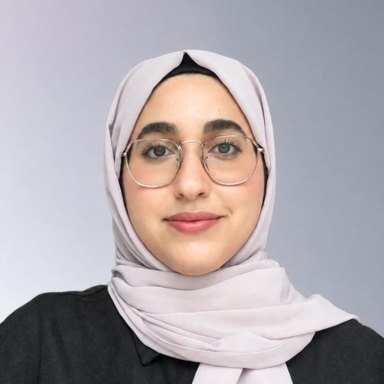
Ikhlas Ben Hmida
The research covers the modelling and design of a soft prosthetic hand. It also explores data-driven decoding of hand and finger motion from surface electromyography.
Ikhlas Ben Hmida is a Global Ph.D. fellow from NYU Tandon School of Engineering and a visiting graduate research assistant at the REACH Lab at NYUAD, where she is conducting her PhD research.
Her research interests include soft robotics, bio-inspired systems, and medical applications of robotics. She is currently exploring data-driven approaches to decoding hand and finger motion from surface electromyography (sEMG) to advance human-machine interfaces and dexterous prosthetic and assistive hands.
Publications since 2024
EEG Motor Imagery Classification: Tangent Space with Gate-Generated Weight Classifier
Biomimetics
@article{omari2024eeg,
  author  = {Omari, S. and Omari, A. and Abu-Dakka, F. and Abderrahim, M.},
  title   = {{EEG Motor Imagery Classification: Tangent Space with Gate-Generated Weight Classifier}},
  journal = {Biomimetics},
  year    = {2024},
  volume  = {9},
  number  = {8},
  pages   = {459},
  doi     = {10.3390/biomimetics9080459}
}
Clasificación de señales EEG para aplicaciones BCI de imaginación motora
Jornadas de Automática
@inproceedings{omari2024clasificacion,
  author    = {Omari, S. and Omari, A. and Fichouche, M. A. and Abu-Dakka, F. J.},
  title     = {{Clasificación de señales EEG para aplicaciones BCI de imaginación motora}},
  booktitle = {Jornadas de Automática},
  year      = {2024},
  publisher = {Servizo de Publicacións da Universidade da Coruña},
  address   = {Málaga, Spain},
  doi       = {10.17979/ja-cea.2024.45.10957}
}